
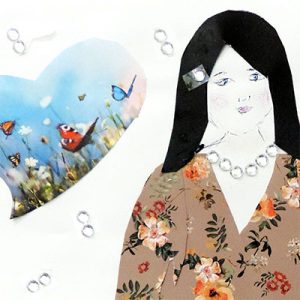
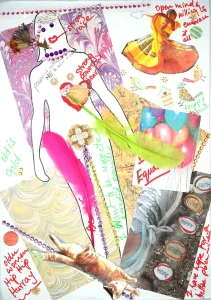
The balloons and butterflies are my freedom. After years of control, I can finally breathe, stand tall, and live life on my own terms.
I called my Body Map Happy Freedom. I’ve been married twice, and both relationships were controlling. The second marriage was the reason I retired early and moved to a rural community. It feels so good to finally be free of him. I love my freedom.
My second husband once said to a close friend, “How do I change her? How do I get her to do what I want?” My friend told him plainly that I’m a strong woman, and he wouldn’t be able to control me. She was right.

There’s nothing holding me back anymore. The balloons and butterflies on my Body Map show that freedom — the lightness of being able to live life on my own terms. I love to celebrate. It’s my birthday soon, and we’re going out to dinner. I’ll be 79, and I don’t care. It’s just another year.

The grass at my feet represents being grounded. The rose petals are there because flowers are beautiful — and beauty makes me happy. A bunch of flowers on the table lifts my spirits. I added flowers to my ankles on the Body Map simply because they’re pretty.

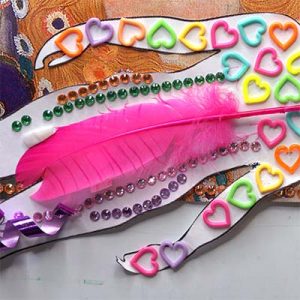
The photograph under my Body Map shows hands. I chose it because I’m a worker. I believe you’re only as good as your team, and I’m lucky to work with a wonderful one. We’re a volunteer organisation promoting older women’s health, and we really do support one another.

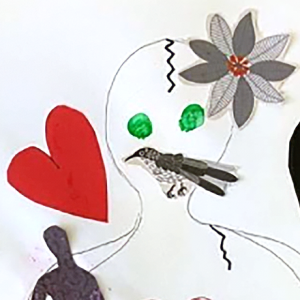
The bird on my chest symbolises freedom, and the heart represents that I am a heart person — I care deeply about others. The flowers on my breast are there simply because I like flowers.

I also brought an image of the female reproductive system from home. I had a hysterectomy at a young age, probably due to endometriosis. Thankfully, I’d already had my children. One of the organisations I work with recently launched an Endometriosis and Pelvic Pain Education program, and they’re running workshops now. There’s so much more awareness these days.
My mother left when I was eleven — far too young to face puberty and everything that comes with it without a mother’s guidance. My grandmother stepped in. She had old-fashioned ideas but was loving and kind. She guided me the best she could.
My dad was my mentor. He always told me I could do or be anything I wanted — as long as I was a lady. I wasn’t allowed to ride a bike, though. There were still things girls “couldn’t do.” But he was a good man, and I loved him deeply.
My first marriage ended after twelve years. I was left with two children to raise and very little money. I went back to work and got on with life. I don’t hold any bitterness. I’m a survivor.
It was my second husband who wanted to move to the regional area where I now live. I gave up my job to move with him. Looking back, I’m grateful he’s gone. He was a danger to me. During mediation, the mediator warned that he might kill me. She told me to change the locks — I already had. My daughter even installed a sophisticated security system in my home.
When I went to the police about the threatening texts he sent — saying that if I were dead, he’d get everything — they didn’t take it seriously. When I said there were a dozen messages, the officer told me, “Come back when you have hundreds.” That’s how it was then.
I worry for the women up here who are worse off than I was. Many have left their homes and are now renting or living in hotels because of family violence. Why should women be the ones who have to leave? It should be the perpetrator who goes.
One of the barriers for older women seeking help is pride. Another is that services aren’t always welcoming. I once asked a service provider what they were doing to make older women feel comfortable — the answer was “nothing.” That says it all.
Service providers need to realise that older women who reach out are often traumatised and need care, not bureaucracy. Having mature women working in those roles would make a big difference.
You’re only as good as your reception. Imagine being an older woman who has lost everything, walking into an office for help, and being barked at to “sit there.” Many don’t come back. Providers notice that, but they rarely ask why.
Employment is another issue for older women. I once sat on a board where we discussed how hard it is for women who’ve worked all their lives but never written a résumé. The job market has changed, and they’re left behind.
Older women need compassion and understanding. Workers with lived experience are often the best at providing that. You don’t need to have lived it — but it helps.
In our group, one woman disclosed family violence and sexual assault. I showed her compassion, and she’s since brought other women in similar situations to join us. Understanding without judgment makes a huge difference. People say, “You need to leave,” but they don’t ask, “Where will you go?”
There are so many women sleeping in cars with their kids. It breaks my heart. Our local council didn’t even have a homelessness policy until recently. I’ve worked hard to change that, and now they’re listening. They have a Positive Ageing Strategy — it looked nice on paper but wasn’t being implemented. That’s changing too.
Reflections on the workshop
One of the best outcomes of the Body Mapping workshops is the friendship I’ve gained with another participant. We’re from different organisations, but now we collaborate. When we saw each other at an event recently, she came straight over, smiling. That connection means something.
I didn’t find the workshop “wow” at first. I couldn’t quite get into it emotionally because I was looking at it from a professional training perspective — analysing what we were achieving. I led with my heart, though, and I saw its value. I could see how powerful it was for others.
It was a shame the Women’s Health Service didn’t participate. We’ve partnered with them before on ageing well programs. We need to make sure women’s health includes all women, of all ages.
The workshop was thoughtfully run. It was a small group, and that made it feel safe. Everyone got individual support, and some of the women really needed that.
One woman told me later that the workshop changed her life. It helped her move forward — she’d been holding onto pain that pushed people away. Hearing that meant a lot.
See more Body Maps
Support the Work of the Older Women's Network.
Join. Amplify. Transform.