
I saw a hibiscus in a shop and thought, ‘If I can’t go to Queensland and see flowers, I’ll wear one myself.’ The flower became my strength. I’m still standing.
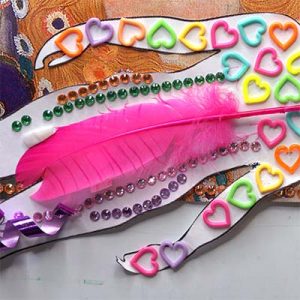
I started my Body Map with my arms crossed in front of me — blocking contact from other people. That’s my protection. Life has taught me that if you let people in, they can take advantage of you.
I’m cautious about trust.

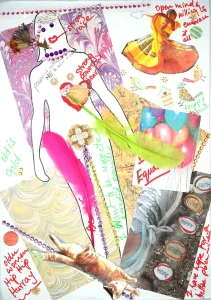
The black hearts on my Body Map represent the people who haven’t contributed to my life in a positive way. One of them is my mother. She was a cruel and vindictive woman. She told us she only belted us “where there was fat” so the bruises wouldn’t show.
She warned us not to tell anyone because they’d “take us away” — and if we thought life was bad at home, she said it would be worse if we were taken. I grew up knowing there was no one else to look after us.
The other black hearts stand for the men who have let me down — the controlling, manipulative ones. I was left eight months pregnant, not realising I’d been the “other woman.” I thought it was love. I used a doily and glitter across my genitals on the Body Map because that was how I kept them happy — by giving them what they wanted, hoping for love in return.
Since my last relationship, I only have sex on my own terms. I’m not going to get hurt again. It’s casual, not emotional, and that’s fine by me. Men worry I’ll fall in love with them — as if they’re irresistible. They’re not. I’ve had long-term relationships, but I’ll never do emotional entanglement again.
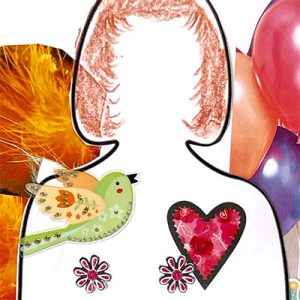
Some people have loved me genuinely — kind, caring, not demanding. My heart is red because I still want to give and receive love. These days, that love goes mainly to my granddaughter. Her mother is manipulative, like my own mother was, and I have to tread carefully.

The bird across my mouth represents the silence I’ve had to keep to stay close to my granddaughter. Her mother needs to feel powerful. So I stay quiet to protect the relationship. The painted rock on my Map represents her — she’s an Indigenous woman, and it’s a reminder that not all abuse comes from men.

Other parts of my Body Map tell of physical scars. I was hit by a car that ran a red light — the driver lied to the police and was never charged. She was young, pretty, and crying; I was older, injured, and dismissed. I’ve also had scars from surgeries — a tubal ligation my partner demanded before he’d sleep with me, a hysterectomy a year later, an appendectomy before that. When I had my hysterectomy, the surgeon told me he made the scar neat so I’d “look great in a bikini.” What a nice man.

My power is shown by the flower in my hair. I started wearing one after a failed relationship — we’d planned a boating holiday, then he cancelled. I saw a hibiscus in a shop and thought, “If I can’t go to Queensland and see flowers, I’ll wear one myself.” The flower became my strength. I’m still standing.

The two figures between my legs on the Map represent my relationship with my son. He lives with a mental illness and an altered sense of reality. I’ve learned not to challenge his beliefs — his world feels real to him. He once lived with me for four years while I worked full-time and cared for my granddaughter. It was chaos. I was exhausted. One day, I wrote in Texta over every mirrored surface in the house: I just can’t take it anymore. When my son saw it, he said, “Mum, you’re scaring me — I think you’re crazy,” and he moved out.
For years he went from boarding house to boarding house, some burned down, and he thought the police were after him. Now he finally has a diagnosis and a permanent place to live. It took fourteen years. When he moved out, it was life-changing. The house became mine again. I love him, but it was hard.
People love to give advice. If I tell someone what’s going on, I don’t need fixing — I just need to be heard. Don’t tell me what to do. I’ve made it this far by being strong and capable.

Reflections on the workshop
When we introduced ourselves in the Body Mapping workshop, I chose a photograph of a flower growing through concrete. That’s me — even when life is hard, there’s still enough soil for something to grow. That’s my positivity.
I wasn’t sure what to expect, but I knew I had stories to tell. Life hasn’t been easy, but there are silver linings. My son’s struggles have given me a closer bond with my granddaughter.
At first, I thought maybe I didn’t belong in the workshop — that there was a certain “type” of abuse needed to qualify, like elder abuse. But I soon realised every story matters.
It was a small, interesting group. I did feel uneasy when two women I know socially turned up — they stayed quiet while I shared deeply. It made me feel exposed, but I’m still glad I participated.
I loved the Body Mapping process. Seeing how differently each woman interpreted it was incredible. You told us we didn’t need templates because we were creative — and you were right. The day flowed beautifully, and sharing our stories made it powerful.
I left feeling lighter. It was a marvellous experience.
I believe the key to wellbeing for older women is involvement in groups. Service providers need to understand that many of us carry deep hurt, and that affects how we connect and seek help. We need opportunities to come together, talk, and belong — not just physical activity, but social connection too.
Groups like the Older Women’s Network are safe spaces. We know each other; we’re seen and respected. That sense of safety makes all the difference.
For women who are homebound, someone should reach out regularly — like the Red Cross calls. Connection saves lives.
Service providers also need to listen. Our experiences shape how we respond and what we need. I still distrust the police after they failed to charge the young woman who hit me with her car — they said there were “conflicting stories.” They believed her, not me. That stays with you.
A friend of mine with home care stopped trying to get them to help the way she wanted. They wouldn’t listen, so she just had tea with them instead. Older women know what they need. Service providers should listen rather than assume.
If abuse happens at home, it shouldn’t be the victim who has to move — the perpetrator should. And home care workers should be able to report concerns or help complete advance care directives when families don’t.
I think Body Mapping should be offered regularly through OWN as a creative and healing activity — not just a research project. With trained facilitators, it could help more women process their stories, find purpose, and heal. Putting your life on paper helps you see it clearly — and that’s powerful.
See more Body Maps
Support the Work of the Older Women's Network.
Join. Amplify. Transform.